- The Hero Project #1: Are All Heroes On the Same Journey?
- The Hero Project #2: Are Hero Stories Actually Empowering?
- The Hero Project #3: Can Heroes Really Start At Zero?
- The Hero Project #4: Do Heroes Need Special Skills?
- The Hero Project #5: So What Is A Hero Anyway?
- The Hero Project #6: Nine Types of Heroes
- The Hero Project #7: Two More Rare Categories
- The Hero Project #8: Skills Are Where You Find Them
- The Hero Project #9: Freud and Jung and Tony and Don
- The Hero Project #10: First, You Have to Not Want to Change
- The Hero Project #11: But What About Hitchcock?
- The Hero Project #12: Hitchcock's Ill-Equipped Heroes
- The Hero Project #13: Hitchcock In The Shadowlands
- The Hero Project #14: So Why Categorize?
- The Hero Project #15: Hit The Ground Running Uphill
- The Hero Project #16: Now Meet the Villains
- The Hero Project #17: Beware of Default Mode
- The Hero Project #18: The Cockeyed Character Creation Checklist
- The Hero Project #19: The Ultimate Question
- The Hero Project #20: Weakness Strikes Back
- The Hero Project #21: Cheers Vs. Fears
- The Hero Project #22: The Wrong Person to Pick On
- The Hero Project #23: Why Do They Fail?
- The Hero Project #24: He Knew You Were Going To Do That!
- The Hero Project #25: Two Villains, Two Heroines, One Good Movie
- The Hero Project #26: Been Up So Long It Looks Like Down To Me
- The Hero Project #27: Inconvenient Revelations
- The Hero Project #28: The Monster At The End Of This Book
- The Hero Project #29: Is Every Hero A Luke Or A Han?
- The Hero Project #30: Putting It All Together!
Podcast
Monday, May 22, 2017
The Hero Project: The Archive
Thursday, February 03, 2011
The Hero Project #30: Putting It All Together!

At the time, I just ignored the difference, even though I should have dug into it and tried to figure out what it was trying to tell me. Did it mean that movies with an earlier “lowest point” were change-movies and those with a late “lowest point” were individuation movies? Or could it mean that the same hero can be on two different simultaneous arcs and will hit two different “lowest points”, one external and one internal? This week’s pieces have unexpectedly forced me to go back and deal with this discrepancy. Because now I think I have the answer. I’m ready to offer an all-new integrated change/individuation arc! Try to contain yourselves!

Yesterday, I considered the possibility that every hero is a Luke (an inherently good person who thinks he’s a failure, then learns to know his own strength) or a Han (a moral failure who thinks he’s a good person, then finds he has to change his ways). But actually, most heroes have aspects of both arcs. Even Luke and Han aren’t all-Luke or all-Han, since they each get more complex over the course of the trilogy. By the third movie, Luke is on a change arc (going from wanting to kill his father to trying to save him) and Han is on an individuation arc (learning to accept and own the heroic, love-smitten role that had grated so badly against his instincts in first two movies)

- First quarter: We meet a hero who knows what they want but not what they need. They’re clever and responsible about pursuing their short-term goals, but clueless about their own true nature.
- Inciting incident: They discover a scary-but-promising opportunity to get what they think they need. This often happens in a humiliating way, increasing their unhappiness with their social situation.
- Second quarter: They pursue this goal the easy way and have some fun doing it. It looks like they’re going to get a lot of gain for a little work.
- Midpoint crisis: Everything comes crashing down. They lose their place of safety. They realize that they stand to lose more than they every hoped to gain, but it’s too late to go back now…
- Third quarter: They start over, doing it the hard way, and begin to make real progress, but this progress ironically makes the task even more personally painful, due to both external and internal consequences that it brings about for them.
- Spiritual crisis: As a result of their hard work, the hero finally confronts what they haven’t wanted to admit about themselves (either an inner strength which they finally accept or an inner flaw which they finally reject)
- Final quarter: adding their newfound inner breakthrough to the external progress they’ve been making since the midpoint, the hero resolves their problem in a way that gets them what they need, without necessarily getting them what they originally wanted.

- We first meet Luke as a frustrated farmer who wants to be a rebel pilot.
- Inciting incident: He gets yelled at for purchasing a droid that keeps trying to run away and join the rebellion (exposing Luke’s own inner desire to do the same). Luke tries to solve R2’s problem…
- This leads him to Obi Wan, who tells him about his greater destiny. He waffles on this, until the empire makes the decision for him…
- Midpoint crisis: Luke realizes his waffling has had horrible consequences: Dallying with rebels has been enough to get his whole family killed, even though he hasn’t really helped the rebellion at all yet. He commits fully.

- In the third quarter, Obi Wan teaches him to use the force and become a hero.
- Spiritual crisis: Obi Wan is killed, sending him back to his original goal, become a pilot for the rebellion.

- In the final battle, he hears (imagines?) Obi Wan’s voice telling him to use his inborn skills, not try to be like the other pilots. He does so and saves everybody.

- Han is hiding out in a wretched bar after screwing up his last job. He gets a huge opportunity to do a sketchy job that will get him the money and maybe even a hot chick.
- Inciting incident: While he’s deciding to take it, a bounty hunter comes to kill him but Han shoots first (got that?), forcing him to commit…
- In this shortened arc, we get only a brief period of things going well. His new clients turn out to be honorable guys and he impresses them with his lightspeed piloting, but…
- Midpoint crisis: He loses his beloved ship to the empire and finds himself flushed down the garbage chute surrounded by enemies. Even the girl is unimpressed with him.

- In the third quarter, he fights back, gets his ship back, impresses the girl, and even gets paid!
- Spiritual crisis: He tells his new friends that he’s off to pay off his creditor even though this is just when they need him most. Luke tells him “Take care of yourself, Han. I guess that’s what you’re best at, isn’t it?” Han feels humiliated. He realizes, but won’t admit, that he’s always wanted the wrong things in life.
- He leaves but, at the last second, comes back and saves everybody, no matter what the personal consequences.

Wednesday, February 02, 2011
The Hero Project #29: Is Every Hero A Luke Or A Han?

Think of the end of the movie. Luke ends up attacking the empire, which is exactly what he wanted in the beginning, though he never thought he would get there. Even when he’s there, he thinks he has to succeed by being like the others, until Obi Wan tells him he can only succeed by using his unique, inner strength. Han, meanwhile, also shows up at the end to attack the Death Star, but this is the last place he wanted to end up when we met him. He still refuses to do it until the last minute, and with good reason. He’s just gotten paid off and he needs to go get a bounty off his head, but suddenly that goal pales in comparison to the new, unfamiliar feelings of heroism that seize him. As we’ll see in the next movie, he has indeed lost his last chance to pay Jabba back, but in this movie it’s worth it, because he now values his friends more than his own skin.
When we meet him, Luke is a great person who thinks, incorrectly, that he’s a failure (because he didn’t go off to join the rebellion with his friends). Instead, he discovers, ironically, that the rebellion needs his farm skills (shooting at womprats) more than any skills he would have learned at pilot school. Han is the opposite. Han starts off as a failure who thinks, incorrectly, that he’s a great person. He needs to develop self-doubts so that he can become a hero by doing the opposite of his instincts. Both journeys make for strong stories. Overlaying the two journeys on top of each other was genius.

I am nothing if not a fan of easy dichotomies, so this leads me to ask a big question: Is every hero a Luke or a Han? If the hero starts out with low self-esteem, does he need to discover that he’s been wrong to doubt himself—and vice versa, if the character starts out with high self-esteem, does he need to discover that he’s been wrong to value himself so much? Maybe this is one reason why some of my heroes have been underwhelming! The problem was not so much that they were Worst Possible Picks, but that I was writing about heroes with low self-esteem who tried to achieve success by doubting themselves even more. But that’s a journey that lacks irony. Audiences love irony: they like the lowly to be wrong about themselves and those with swagger to be wrong about themselves.
Or can the two separate ideas exist within the same journey? In my original post about change and individuation arcs, there was a blatant discrepancy between the two structures, though I ignored it at the time. (Can you spot it?) Suddenly, this discrepancy is resolving itself… A new unified structure is dawning in my mind… Come back tomorrow!
Tuesday, February 01, 2011
The Hero Project #28: The Monster At The End Of This Book

Oedipus was unable to forgive himself, gouged his own eyes out and went to live as a hermit. Grover, on the other hand, found the whole situation to be quite groovy. Most hero/villains are somewhere in between. Dana Andrews in Where the Sidewalk Ends thinks that all of his own sins will be forgiven if he can just catch the big gangster, and he’s right, but then he discovers to his chagrin that he can’t accept getting away with it, so he suddenly confesses his murder. Michael Clayton, on the other hand, realizes that he’s crooked (“I’m the guy you buy off!”) just in time to turn himself around.
Many romantic comedies end this way. In idiotic movies like 40 Days and 40 Nights or How To Lose A Guy In Ten Dates, the hero realizes that the thing standing in the way of true love is the arbitrary anti-true-love rule they adopted at the beginning of the movie. Well, duh. In better movies like Annie Hall or (500) Days of Summer the hero stops blaming everybody else and starts blaming himself for his romantic delusions, no matter how painful that is.
But to a certain extent, this should happen in all stories, to all characters. In real life we often believe that we can’t better our lives (get a better job, find a spouse, deal with injustices) because, if we were to try, there would be external forces that would knock us back down. But on those occasions when some inciting incident forces us to get off our ass and try it, we discover that, even after all the obstacles are cleared, we’re still unwilling to change our lives or the world. It’s horrible to discover that you were merely using external obstacles to justify your own mental paralysis. Now that you’ve cleared your excuses away, you have to face the last enemy: your own wretchedness. This is a big part of any story, and one of the hardest parts to write.
At the conclusion of the initial run of the Hero Project, I wondered if quests were really about the hero’s need to change himself (ala Freud), or acknowledge his already existing power (ala Jung). Scott Myers calls this the difference between change and individuation. In my original summation, I showed how Luke’s journey in Star Wars could be seen either way. But though Luke may not actually have to change, he’s got a co-protagonist who certainly does. What about Han? Let’s go there tomorrow…
Monday, January 31, 2011
The Hero Project #27: Inconvenient Revelations

Heroes are investigators. They turn over rocks, exposing worms, but sometimes they find that they can’t root out those worms without undermining their own foundations, at least temporarily. Sometimes, they find out that someone close to them is a traitor (L.A. Confidential, The Matrix), maybe even their love interest (The Sting, The Verdict) Even worse is when it turns out to be a parent, because then they realize that they have the same evil DNA inside them.
Luke Skywalker has an arc in each Star Wars movie, but he also has a big arc over the whole trilogy and his lowest point is obviously when he finds out that Darth Vader is his father. This ruins his adventure, takes all the fun out of his quest, and makes him doubt his own destiny, but ultimately, it provides him with the crucial information he needs to defeat the empire and become a better jedi.
Even more shattering is the realization Dennis Christopher has in Breaking Away. His father runs a used car lot and rips off the local college kids. Christopher rejects his family and chooses to idolize Italian bike racers instead. His dad tries to break him of this mania and forces him to take a job on the lot. One day, some kids his dad ripped off try to return their car and Christopher naively gives them their money back. His father tries to physically block them from pushing the dead car back onto the lot, almost killing himself with a heart attack. Christopher runs off to join a race with his Italian idols, but they betray him too, cheating and running him off the road.
Christopher returns home tearfully to his dad and bitterly laments, “Everybody cheats. I just didn’t know.” He can no longer hide behind the imaginary heroism of the Italians, which means he must accept his father’s wickedness. It’s just about one of the most devastating moments in any movie I’ve seen. But it’s not really a step backward. Christopher is moving forward. This gives him the strength he needs to fix his life and his family, even though it’s incredibly painful.
But there’s another type of lowest point that’s even lower than facing the villainy of a loved one: when you realize the villain is even closer at hand. We’ll get to that tomorrow…
Sunday, January 30, 2011
The Hero Project #26: Been Up So Long It Looks Like Down To Me

So what if your hero isn’t an big dupe? What if they’ve been tackling their problem with pluck and verve, cleverly making real progress the whole way? Shouldn’t they be making their way up the mountain? How can a steady progress of heroic action paradoxically result in a reversal where it feels like they’ve lost everything? We’ve examined the bad version: it was all the bad guy’s plan and all the hero’s progress was false. But what’s the good version? This is what I’ve been thinking about during the long snowy months of the Hero Project’s hibernation...
The simplest way, of course, is to have the hero’s positive actions unexpectedly result in a very negative result: their partner or loved one gets killed by the antagonist. This way, your hero’s action weren’t misdirected or for naught, but they caused a more dire reaction than they could have anticipated. They can still continue from where they left off, but first they have to do some soul searching and decide if the whole thing was worth it. See The Untouchables or Basic Instinct or Dark Knight or a million others.
Of course, that question gets much trickier if the person who gets killed is the only person they were trying to save. Movies like Man on Fire will sometimes try to switch gears on the viewer, going from hopeful rescue thriller to grim grindhouse revenge flick in an instant. It’s not a fatal decision for all audiences, but it is a hard sell.
Even more problematic are those movies where, in the end, the moral calculus just doesn’t add up anymore. Martin Campbell is my favorite action director, and I’ve always wanted to see a good mountaineering thriller, so I had high hopes for Vertical Limit, but it just didn’t work (and not just because they cast Chris O’Donnell): Four people are stranded on a mountain. Six people set off to rescue them before a storm comes. By the time the movie’s over, only one of the rescuers survives, and he only manages to rescue one of the people who was stranded. Yay? If this had been a grim survival drama, maybe that would work, but that was supposed to be a stand up and cheer ending! In the end, the audience doesn’t want to feel that everybody would have been better off if the heroes had just stayed home!
Ultimately, this is a fairly unfulfilling way to knock your hero down before he triumphs. What are some more satisfying reversals? Our next two have one simple phrase in common: The truth hurts. We’ll look at those next…
Sunday, October 10, 2010
The Hero Project #25: Two Villains, Two Heroines, One Good Movie
Thursday, October 07, 2010
The Hero Project #24: He Knew You Were Going To Do That!
I call it the “everything the hero has done is actually part of the villain’s plan” moment. I mentioned before that I always want to send a shiver of dread up the script-reader’s spine and pull the rug out from my characters with a big reversal. Well there’s no bigger reversal, I’ll admit, and it’s an undeniably chilling moment: All the heroic actions we’ve been cheering for are suddenly undone! Even worse, they’ve all been exactly what the bad guy wanted to happen! All of the clever things that the hero has done turn out to be totally predictable—the villain obviously knew in advance everything the hero was going to do. In fact, they were counting on it!
But these moments are risky. Not only do they weaken the hero, but they’re often very hard to believe. You start thinking back through the movie and trying to imagine how the villain could have guessed the hero’s every move. And they cause another problem as well: if the villain really planned this far in advance and predicted everything, then they must be a super-duper-genius! So how will they ever lose? Their plan so far has been utterly brilliant, so if it falls apart now, it had better be for a very good reason.
And that’s where these moments always fall short. So far the hero has done nothing but blunder into the villain’s elaborate trap. They’ve been ten steps behind. Now they need do something so brilliant that they instantly leap eleven steps ahead. But, inevitably, the hero gets out of it by doing something utterly obvious. The same villain who predicted their every move up until this point fails to realize that they’ll fight back after the big reveal.
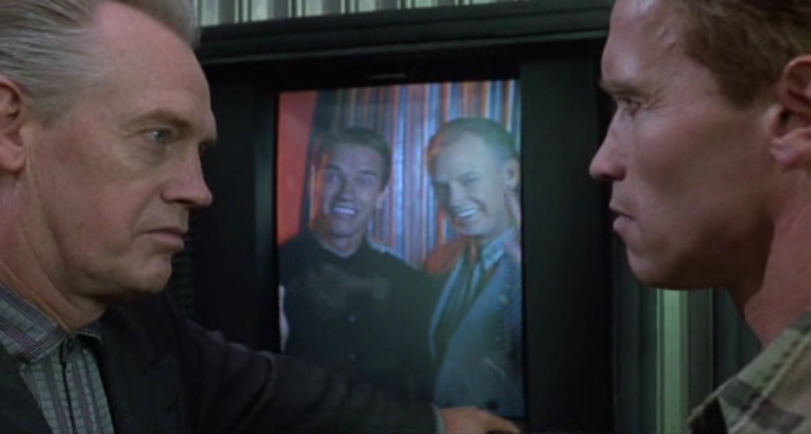
Cox successfully set this all up over the course of “a year’s planning” and the heroic version of Schwarzenegger, unaware that he’s actually a bad guy, walked right into the trap! Now all Cox has to do is restore Schwarzenegger’s evil personality. So he straps Schwarzenegger into the “re-evil yourself” machine, kicking and screaming the whole way. Cox cackles for a while and then leaves the room...
What could go wrong now?? What’s the one thing Cox didn’t count on? Well… nothing much. Schwarzenegger keeps struggling and gets his arm free. That’s what goes wrong. Cox guessed his every move a year in advance, but it never occurred to him that Schwarzenegger might try that. Cox just went from world’s smartest villain to world’s dumbest villain in about two minutes!

The Hero Project #23: Why Do They Fail?
If your story has a villain who is clearly improvising, then we might forgive them if their plan has some holes. But if your story is about a villain who has spent weeks (or longer) laying a trap for your hero, then we are going to hold them to a higher standard. And if your villain describes their entire plan to the hero, then it should really be foolproof. There has to be a good reason for them to confess everything and we have to understand why they thought that this wouldn’t mess up their plan.
For examples, let’s go back to two thrillers I’ve already picked on before:
In Collateral, hit man Tom Cruise gets driven around by cab driver Jamie Foxx. When one of Cruise’s victims falls out a window onto Foxx’s hood, Cruise has to try to win Foxx over to the dark side. I’ll cut this one some slack because Cruise is clearly improvising. Still, why did he think that Foxx would go along with it? And shouldn’t he have figured out that you don’t want to threaten a guy and then leave him sitting in his cab to think it over?
Training Day is a far more ludicrous example. Bad cop Denzel Washington spends the first half of the movie trying to corrupt a rookie played by Ethan Hawke. Hawke doesn’t go for it. Then Washington reveals his real plan: he wants to frame Hawke for all of his crimes. Okay… why tell him that? It makes for a big dramatic “raise the stakes” scene, sure, but it hardly helps him with his plan. And why is he surprised that Hawke fights back? Wouldn’t anyone? Maybe if Hawke had had a history of corruption himself, and today was the one day he unexpectedly decided to be a good cop… but no. This is a classic example of a plot twist that gives the hero more conflict and more motivation in the short run, but ultimately makes both the villain and the hero look weak.
Both movies lack that “this was the wrong person to pick on” moment. The hero just muddles through. It’s no accident that they both attracted a big-money star to play the villain and a smaller star to play the hero. The villain gets to run rings around the hero until the very end.
Nevertheless, both of those movies were nominated for Oscars, so what do I know? Here’s a movie that wasn’t nominated for an Oscar: the Steven Seagal vehicle Under Siege. Nevertheless this one makes a lot more sense. Tommy Lee Jones has planned his villainy down to the last detail, because he wants to highjack a battleship filled with Navy SEALs! That’s a big goal! Unlike Cruise and Washington, Jones has done his homework and thought of everything. He successfully disarms all the SEALs and locks them up. But there’s one thing he hasn’t counted on: the cook has a secret history. He used to be the toughest commando of them all before he got busted down to the kitchen. It’s understandable why Jones didn’t think of that. It’s his bad luck that he ended up a hero who happened to be the wrong person to pick on.
Tommorow we’ll look at the riskiest way of all to escalate conflict...
Tuesday, October 05, 2010
The Hero Project #22: The Wrong Person to Pick On

Here’s the problem: I never really wanted to make people cheer. Just the opposite: I always want to send a shiver of dread up a reader's spine, or to make them blush with furious indignation at unfair treatment, or to yank the carpet from under their feet with a shocking reversal of fortune. Whether I’m writing a bio-pic or a thriller or a comedy, I love to put my hero and my audience through the wringer.
Making an audience feel is great, but it becomes a problem when all they feel is pity. Nobody ever said: “I just saw a great movie, the hero was totally pitiful! I hope he comes back for a sequel!” The audience wants to invest emotion in a hero, and they only invest if they can expect a satisfying pay-off. To get that investment, you have to write about the person they would pick to be the hero, the person that they would choose to root for.
I had the wrong idea that the best way to amp up the conflict is to maximize the challenge to the hero. But then I figured it out: You’re supposed to maximize the conflict for the villain. This changes everything.

But in that case, more conflict would have meant less excitement. Here’s the problem: if Bonnie, with no training and no experience, could take out Hans, then we would suspect that anybody could take out Hans. Ironically, we would feel less tension, not more, with every moment she remained free, because this whole plan would start to seem half-baked. After all, Hans knew that the building would be full of bankers. At the very least, his plan should be banker-proof!
The writers didn’t start out by asking “how do we maximize conflict for our hero?” They asked “How do we maximize conflict for our villain?” Hans drives the movie, and the audience secretly loves him, and he has a great plan. But then a terrible thing happens to him. Something he never could have prepared for: our hero. This was another a-ha moment: The hero needs to be the wrong person to pick on. Let’s pick up there tomorrow.
Monday, October 04, 2010
The Hero Project #21: Cheers Vs. Fears

But a strange thing happens in Godzilla movies: People root for Godzilla! Story gurus all tell you that the hero should be in as much trouble as possible and the villain should drive the plot, but this gospel ignores the lure of the powerful hero. People like to trust their heroes. They like to feel that they are in good hands. They like to live vicariously through a hero’s power and swagger and confidence.
Anyone who has ever tried to choose their favorite superhero has encountered this paradox. Two factors define these guys: their powers and their professionalism. Superman has a maximum amount of both, so he’s the ultimate super-hero, right? Superman launched the whole genre and his comics have appeared every month since 1938 without any serious dips in popularity, so he must be doing something right. But few people pick Superman as their favorite superhero. And those who do tend to be people who don’t actually read comic books. If you do, you quickly realizes the big problem: he’s too damn powerful. The stakes are very low. Most of his enemies can’t harm him even a tiny bit, unless they have some kryptonite and then he collapses like a drunken hobo, so it’s all or nothing with this guy.

So who do most comic readers pick as their favorites? Just ask Chris Sims, who, as usual, speaks for most fans: Batman and Spider-Man. Batman is a consummate professional but he has no super-powers. Spider-Man, on the other hand, had powers land in his lap but he’s happy to be a perpetual amateur at the hero biz. Either way, they end up in over their head quite often. Batman is going up against powerful supervillains armed with only leather tights and his weighty tool-belt. That’s brave! That’s dangerous! Spider-Man, meanwhile, is taking on lifelong Mafiosi even though he’s just a moonlighting schoolkid. Sure, he’s got powers they don’t have, but he’s hardly bulletproof. We worry about these heroes. And we like to worry, to a certain extent.

Superman is all cheers. Kick-Ass was all fears. Batman and Spider-Man each find a happy medium, in their own way. Audiences are happiest when they get to cheer and fear for a hero. But if you’re not writing a superhero movie, how do you balance those two? How do you maximize conflict without weakening the hero? Tune in tomorrow, same bad-ass time, same vulnerable channel.
Sunday, October 03, 2010
The Hero Project #20: Weakness Strikes Back

When I was done, I sat down and read my own first draft. I was shocked: the protagonist was still unskilled and passive. I was baffled. Am I obtuse? How had this happened?
In discussing this issue before, I had blamed bad messaging. Freud had led me wrong, or Joseph Campbell, or Hitchcock. The problem was that I had been unaware that protagonist should be badasses. If I just rejected the false gospel of the unskilled hero, I would be fine. But even when I’m consciously running away from those bad ideas, I end up right back where I started.
Now I see another issue at play. No matter how much I want to have a skilled hero, there are two even stronger counterforces that conspire to turn my heroes into weaklings: Motivation and Conflict. I have always been very aware of the need to maximize both motivation and conflict. What I hadn’t realized was that these two values threaten to undermine two other values: Trust and Respect.
Here’s one of the “truisms” I have often cited about screenwriting: “The basis of any story is that you put your character up in a tree and you throw rocks at them. If you’ve got a problem with your story, it’s probably because they’re not up in a tree (not enough motivation) or you’re not throwing rocks at them (not enough conflict).” This has always been gospel to me. Even when I discovered that my heroes weren’t earning the trust and respect of my readers, I thought I could just add some badass-ery and some vulnerability to my pre-existing formula. But all of the trust and respect I added somehow leached out again between the outline and the finished work. Why? Not because I didn’t value it, but because I valued motivation and conflict more. And the easiest way to maximize motivation and conflict is to give your hero less proactivity and fewer skills.
So the real question is: which is more important, fears or cheers? We’ll pick up there tomorrow.
Friday, September 10, 2010
The Hero Project #19: The Ultimate Question
Thursday, September 09, 2010
The Hero Project #18: The Cockeyed Character Creation Checklist

- Age: You have to list this for every character, along with…
- The one-line description: Often in the pithy form of “the sort of person who…”
- Who might play them: Don’t put this on paper, but it’s vital that you have a general sense of this. (And if someone considers buying it, this is the first question they’ll ask you.)
- General role in the story: Are they the Hero, Villain, Love Interest, or Friend?
- Within this role, what is their type: As we’ve been discussing.
- Moment the audience decides to trust them or loathe them: You must know this. Don’t be ashamed to do your biggest and toughest job-- make the audience care.
- Stated Goal: What they say they’re after. (for instance: justice)
- Secret Goal: What they want out of it that they’re not telling anybody. (for instance: the love interest)
- Emotional Arc: How many emotional states do they pass through along the way?
- Profession: Yes, you always need to know this. Even if they find themselves being chased by a mad gunman on page 2 and never go to work.
- Where they work: Where is it and what’s it like and what are the hours? Of course, you don’t have to tell the audience all of this. Know more than you show.
- How they talk: This is the hardest thing to know in advance. When I prepare to write a new character, I always fear that they will never “talk” to me. Sometimes I have them talk like a friend of mine. Sometimes like a famous person. To a certain extent, their language will be determined by their job. One thing I like to do before I begin a script is to read a memoir by someone in that profession so that I’ll internalize the language. Obviously, however, that can’t be the only factor, because when we see them at work, they can’t talk like everybody else.
- Physical habits: Many scripts don’t list these, and the actors love to make them up themselves, but sometimes it’s good to actually put it on the page. For one thing, if you use more body language you can use less dialogue.
- Hobby: Not always mentioned, but good to know.
- Totem object: As discussed.
- Badass-ery, special skills: Likewise.
- Vulnerability, ordinariness: Maintain that badass/vulnerability ratio!
- Secret they’re keeping: No matter what kind of movie it is, this can add a lot. Secrets make it a whole lot easier to add subtext to dialogue.
- Secret being kept from them about their past: Which is sometimes, but not always, the same thing as:
- Biggest shock coming: Whether they’re the hero of villain, everything shouldn’t go according to their plan. Make them improvise!
- When the audience will really worry about the character: Hint: it can’t be the first scene. This is when you cash in the trust that you’ve built up. Just when you’ve gotten the audience to let down their defenses, stick a knife in them and twist it. They’ll love you for it.
- How their first action foreshadows their action for the rest of the script: This is always a great trick when you can pull it off.
- Moral center: What is the thing they just won’t do? This is an especially good way to define a villain.
- Their philosophy: An actual line of dialogue that sums up how they think about the world. Every character has a philosophy, whether they know it or not.
- Danger zone: Is there any reason that the audience may not react to this character the way that you want them to? Some reason they might not find your hero sympathetic? Or might be underwhelmed by your villain? Be aware of the uphill battles that you’ll have to fight to make this particular story work.