
Updated to the sixth and final checklist!
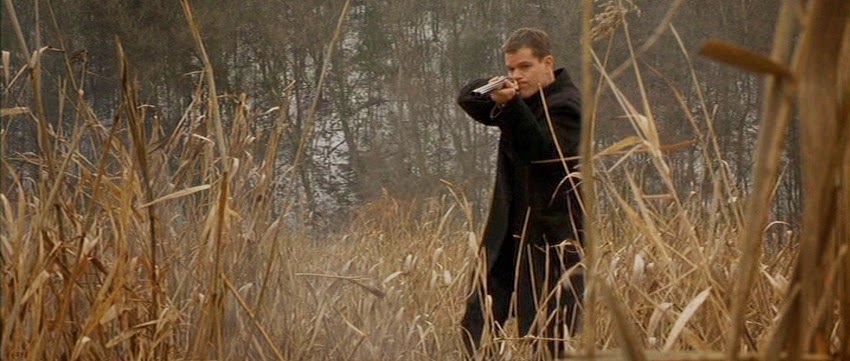
Jason Bourne is pulled from the sea by a fishing boat, bullet-riddled and suffering from amnesia. Teaming up with a drifter named Marie, he pieces together his past and discovers that he was a CIA assassin that had a crisis of conscience during an attempted assassination of an African ex-dictator named Wombosi. After dispatching three of his former colleagues sent by the CIA to kill him, Jason finally decides to take the fight to old boss Conklin.
PART
#1: CONCEPT 19/19
|
|
The Pitch: Does this concept excite everyone who
hears about it?
|
|
Is the
one sentence description uniquely appealing?
|
A spy with no memories must determine who he was and who he
wants to be now, while his ex-bosses try to kill him.
|
Does
the concept contain an intriguing ironic contradiction?
|
Yes, A spy with a conscience
becomes the latest target of his own agency.
|
Is this a story anyone can identify with, projected onto
a bigger canvas, with higher stakes?
|
It’s a metaphor for anyone who is
disgusted by what he’s become
|
Story Fundamentals: Will this concept generate a
strong story?
|
|
Is the
concept simple enough to spend more time on character than plot?
|
Yes, there are no plot twists in the
second half, just character twists.
|
Is
there one character that the audience will choose to be their “hero”?
|
Yes, Jason, although our loyalty to him
is tested at times.
|
Does
the story follow the progress of the hero’s problem, not the hero’s daily
life?
|
Yes.
|
Does
the story present a unique relationship?
|
Yes, the spy and
the bohemian.
|
Is at
least one actual human being opposed to what the hero is doing?
|
Yes, Chris Cooper.
|
Does
this challenge represent the hero’s greatest hope and/or greatest fear and/or
an ironic answer to the hero’s question?
|
Yes, his big
question “who am I?” at first means “Who was I?”, then it become “Who do I
want to be now?”
|
Does
something inside the hero have a particularly volatile reaction to the
challenge?
|
Yes, both before
and after his amnesia: seeing Wombosi’s kid caused an unexpectedly volatile
reaction, not just the coincidence of getting hit in the head.
|
Does
this challenge become something that is the not just hard for the hero to do (an obstacle) but hard for the hero
to want to do (a conflict)?
|
Yes, everything he
finds out about his past makes him not want to go on.
|
In the
end, is the hero the only one who can solve the problem?
|
Yes.
|
Does
the hero permanently transform the situation and vice versa?
|
They shut down the
program because of him. He now knows who he is, and who he wants to be (which
is totally different)
|
The
Hook: Will this be marketable and generate word of mouth?
|
|
Does
the story satisfy the basic human urges that get people to buy and recommend
this genre?
|
Yes and no. It
subtly replaces our normal spy movie expectations (gadgets, secret lairs),
with more modest ones, then it fulfills those expertly: awesome car chase in
a beat-up car, down-and-dirty fight scenes, etc.
|
Does
this story show us at least one image we haven’t seen before (that can be
used to promote the final product)?
|
Sort of: the body
in the water, the unique fighting style, the car chase with the beat-up car.
|
Is
there at least one “Holy Crap!” scene (to create word of mouth)?
|
Yes, the car
chase, jumping down the stairwell with the body.
|
Does
the story contain a surprise that is not obvious from the beginning?
|
Yes: we discover
he didn’t just have his break from being shot, it was because he balked at
his assignment.
|
Is the
story marketable without revealing the surprise?
|
Yes.
|
Is the
conflict compelling and ironic both before and after the surprise?
|
Yes, even moreso
afterwards, because we can finally totally root for him again.
|
PART
#2: CHARACTER 20/22
|
|
Believe:
Do we recognize the hero as a human being?
|
|
Does
the hero have a moment of humanity early on? (A funny, or kind, or oddball,
or out-of-character, or comically vain, or unique-but-universal “I thought I
was the only one who did that!” moment?)
|
Oddly, no, not that I can identify,
although he’s very sympathetic.
Lacking all of those things, his likability is based entirely on two
things: the pity of his plight and his extreme resourcefulness. The rest is all due to the casting of
Damon, with his open, honest, kind face, he imputes all of those MOH
qualities to the character (whereas, based just on the script, he could have
been a bland badass)
|
Is the
hero defined by ongoing actions and attitudes, not by backstory?
|
For the most
part. All we or he know about
him is what he can do, not who he was.
|
Does
the hero have a well-defined public identity?
|
Yes, the
hyper-confident super-spy.
|
Does
the surface characterization ironically contrast with a hidden interior self?
|
Yes, he’s
conflicted and broken.
|
Does
the hero have a consistent metaphor family (drawn from his or her job,
background, or developmental state)?
|
Not really, because he doesn’t have
any of those three. His dialogue
is mostly everyman dialogue, except it’s more direct and efficient (like
everything else about him.)
|
Does
the hero have a default personality trait?
|
Yes, he’s honest,
plainspoken, good-humored.
|
Does
the hero have a default argument tactic?
|
Yes, he puts the
ball in your court (for instance, handing her the money before he asks her to
decide, then asking her to give it back if she wants to say no.)
|
Is the
hero’s primary motivation for tackling this challenge strong, simple, and
revealed early on?
|
Yes.
|
Care:
Do we feel for the hero?
|
|
Does
the hero start out with a shortsighted or wrongheaded philosophy (or accept a
false piece of advice early on)?
|
Yes, he keeps
saying “I just want to find out who I am”, but eventually he comes to want
more.
|
Does
the hero have a false or shortsighted goal in the first half?
|
Well, he gets one
very quickly: find out who he is.
|
Does
the hero have an open fear or anxiety about his or her future, as well as a
hidden, private fear?
|
Open: that he’ll
be killed or captured. Private: that he’ll discover he’s not a good person
|
Is the
hero physically and emotionally vulnerable?
|
Moreso the latter,
because he’s pretty invulnerable once he’s in action, but the frequent shots
of the bulletholes in his sweater and back remind us on the one time his skills failed him.
|
Does
the hero have at least one untenable great flaw we empathize with? (but…)
|
Yes, he’s been
dehumanized and snapped like a broken machine.
|
Invest:
Can we trust the hero to tackle this challenge?
|
|
…Is that great flaw (ironically) the natural
flip-side of a great strength we admire?
|
Yes, he’s a living
weapon, and he’s trying to become more human.
|
Is the
hero curious?
|
Yes, very much so.
|
Is the
hero generally resourceful?
|
Yes, very much so: taking the
walkie off the guard he knocks out, taking the floorplan off the wall,
etc.
|
Does
the hero have rules he or she lives by (either stated or implied)?
|
Yes, identify the
exits, identify the threats, avoid capture
|
Is the
hero surrounded by people who sorely lack his or her most valuable quality?
|
Yes, all of the
other spies are less moral than he, all of the other civilians lack his
talents.
|
…And
is the hero willing to let them know that, subtly or directly?
|
He’s reluctant to speak up,
but quick to act, so he’s assertive in his own way.
|
Is the
hero already doing something active when we first meet him or her?
|
Follow the information on the
implant to find out who he is.
|
Does
the hero have (or claim) decision-making authority?
|
Yes, he’s through
taking orders.
|
Does
the hero use pre-established special skills from his or her past to solve
problems (rather than doing what anybody would do)?
|
Yes, very much so,
even though he doesn’t remember where or how he got them.
|
PART
#3: STRUCTURE (If the story is about the solving of a large problem) 19/21
|
|
1st
Quarter: Is the challenge laid out in the first quarter?
|
|
When
the story begins, is the hero becoming increasingly irritated about his or
her longstanding social problem (while still in denial about an internal
flaw)?
|
Yes and no, he
discovers one immediate problem (he doesn’t know who he is) but only near the
end does he discover that this was a culmination of a longstanding social
problem (he was already balking at the job, and that’s what broke him)
|
Does
this problem become undeniable due to a social humiliation at the beginning
of the story?
|
Yes, he literally
becomes a non-entity.
|
Does
the hero discover an intimidating opportunity to fix the problem?
|
Yes, the Swiss
bank account embedded in his hip.
|
Does
the hero hesitate until the stakes are raised?
|
Yes, when he opens
the bank box, he leaves the gun behind: He’s reluctant to use his skills.
|
Does the hero commit to pursuing the opportunity by the
end of the first quarter?
|
Yes, he decides he
won’t let himself be taken and takes a gun from someone else.
|
2nd
Quarter: Does the hero try the easy way in the second quarter?
|
|
Does
the hero’s pursuit of the opportunity quickly lead to an unforeseen conflict
with another person?
|
Yes, he’s almost
arrested, then Cooper finds out he’s alive, sends assassins after him.
|
Does
the hero try the easy way throughout the second quarter?
|
Yes, he tries to
go back to his old life, old apartment, tries to ditch girl.
|
Does
the hero have a little fun and get excited about the possibility of success?
|
Yes, he discovers
what a badass fighter and driver he is. He’s excited to discover his other
name and thinks that will solve the mystery.
|
Does the
easy way lead to a big crash around the midpoint, resulting in the loss of a
safe space and/or sheltering relationship?
|
Somewhat: the new
name leads to a dead end, and he finds that they’ve found his hotel room, so
he decides to flee. At this
point, he loses his relationship for only a moment until he wins Marie back
over.
|
3rd
Quarter: Does the hero try the hard way in the third quarter?
|
|
Does
the hero try the hard way from this point on?
|
It’s somewhat
reversed in this movie, as he spends the second quarter solving the mystery
and the third quarter on the run from his investigation, but he’s definitely
more grim and resolved in the second half.
|
Does
the hero find out who his or her real friends and real enemies are?
|
Yes, he realizes
that his fellow killers aren’t really the problem, it’s the boss, and
realizes that Marie really loves him.
|
Do the
stakes, pace, and motivation all escalate at this point?
|
Yes, he’s in love
now, and realizes that he must find Conklin and “end it” to protect her.
|
Does
the hero learn from mistakes in a painful way?
|
Yes, he almost
gets her family killed (and does get their dog killed), and realizes that he
can’t run any further.
|
Does a
further setback lead to a spiritual crisis?
|
Yes, seeing her
family, he says that he doesn’t want to know who he is anymore.
|
4th
Quarter: Does the challenge climax in the fourth quarter?
|
|
Does
the hero adopt a corrected philosophy after the spiritual crisis?
|
Yes, “I don’t want
to know who I am anymore.” He
only cares about what he can become.
|
After
that crisis, does the hero finally commit to pursuing a corrected goal, which
still seems far away?
|
Yes, he decides to confront
his ex boss.
|
Before
the final quarter of the story begins, (if not long before) has your hero
switched to being proactive, instead of reactive?
|
Yes, at just this point.
|
Despite
these proactive steps, is the timeline unexpectedly moved up, forcing the
hero to improvise for the finale?
|
No, he remains in control of the
timeline until the end.
|
Do all
strands of the story and most of the characters come together for the
climactic confrontation?
|
No, the girl isn’t there, but that’s
fine.
|
Does
the hero’s inner struggle climax shortly after (or possible at the same time
as) his or her outer struggle?
|
Yes, he finally
figures out who he really is as he confronts the bad guy.
|
Is
there an epilogue/ aftermath/ denouement in which the challenge is finally
resolved (or succumbed to), and we see how much the hero has changed
(possibly through reversible behavior)
|
Yes, he tells her
that he has no ID and smiles.
|
PART
#4: SCENEWORK 18/20 (Jason and Marie are attacked at her family’s farm by the assassin known as The Professor. Jason blows up a propane tank to distract him and kills him, but as The Professor dies he convinces Jason to come back.)
|
|
The
Set-Up: Does this scene begin with the essential elements it needs?
|
|
Were
tense and/or hopeful (and usually false) expectations for this interaction established
beforehand?
|
Yes, we know that
the CIA have figured where there are, know that the professor is very good,
know that the relatives don’t trust Jason or Marie, know that the dog is
usually around.
|
Does
the scene eliminate small talk and repeated beats by cutting out the
beginning (or possibly even the middle)?
|
Yes, it’s very
jump-cutty in the middle.
|
Is
this an intimidating setting that keeps characters active?
|
Yes, it’s snowing,
has an explosive tank, has innocents inside, etc.
|
Is one
of the scene partners not planning to have this conversation (and quite
possibly has something better to do)?
|
Yes, Jason and
Marie wanted to leave.
|
Is
there at least one non-plot element complicating the scene?
|
Yes, the dog, the
kids, the birds, the mention of the headaches.
|
Does
the scene establish its own mini-ticking-clock (if only through subconscious
anticipation)?
|
Jason has to get
to him before the smoke clears (and get back before Marie and the relatives
flee)
|
The
Conflict: Do the conflicts play out in a lively manner?
|
|
Does this scene both advance the plot and reveal
character through emotional reactions?
|
Yes. The Professor
and Jason are both moved by their interaction. Marie is very upset.
|
Does
the audience have (or develop) a rooting interest in this scene (which may
sometimes shift)?
|
Yes, we very much
want Jason to keep Marie and her relatives safe, but we’re also sympathetic
to the man he must kill to do so.
|
Are
two agendas genuinely clashing (rather than merely two personalities)?
|
Yes, the professor
wants to kill Jason, Jason first wants to be left alone, then wants to
neutralize the threat, then wants info.
|
Does
the scene have both a surface conflict and a suppressed conflict (one of
which is the primary conflict in this scene)?
|
Surface: kill each
other, Suppressed: seek redemption for being assassins, answers for how they
got this way.
|
Is the
suppressed conflict (which may or may not come to the surface) implied
through subtext (and/or called out by the other character)?
|
Not really, it’s rather subtext-free.
|
Are
the characters cagy (or in denial) about their own feelings?
|
Not really, it’s all out in the open
here.
|
Do
characters use verbal tricks and traps to get what they want, not just direct
confrontation?
|
Jason uses a
spectacular non-verbal decoy to avoid direct confrontation
|
Is
there re-blocking, including literal push and pull between the scene partners
(often resulting in just one touch)?
|
Quite a bit of
re-blocking. Jason never touches
the professor, but the kids hug their dad.
|
Are
objects given or taken, representing larger values?
|
Bullets are
exchanged, then the professor’s stuff is taken.
|
The
Outcome: Does this scene change the story going forward?
|
|
As a
result of this scene, does at least one of the scene partners end up doing
something that he or she didn’t intend to do when the scene began?
|
Yes, the professor
dies, Jason decides to stop running.
|
Does
the outcome of the scene ironically reverse (and/or ironically fulfill) the
original intention?
|
Yes, the professor
dies but ironically succeeds in bringing Jason in.
|
Are
previously-asked questions answered and new questions posed?
|
Previous: Jason finally gets the name Treadstone, finds out a little bit
about his training and mental conditioning. New: How can he find Treadstone? What is this stuff the professor has?
|
Does
the scene cut out early, on a question (possibly to be answered instantly by
the circumstances of the next scene)?
|
It cuts out on the
professor’s line, “Look what they make you give.” This sets up Jason’s decision to split with Marie for now.
|
Is the
audience left with a growing hope and/or fear for what might happen next?
(Not just in the next scene, but generally)
|
We are
expecting some the climax.
|
PART
#5: DIALOGUE 14/16
|
|
Empathetic:
Is the dialogue true to human nature?
|
|
Does
the writing demonstrate empathy for all of the characters?
|
Yes, most. There could be a little more for
Cooper, but he’s a good enough actor to help his character hold his own.
|
Does
each of the characters, including the hero, have a limited perspective?
|
Very much so. Nobody, good or bad, is ever exactly
sure what’s going on.
|
Do the
characters consciously and unconsciously prioritize their own wants, rather
than the wants of others?
|
Very much so. This is a very realistic portrayal of
spying, they’re assassinating their former assets, not fighting against evil.
|
Are
the characters resistant to openly admitting their feelings (to others and
even to themselves)?
|
Yes, the excellent
love scene starts with him dying her hair, which forces them into intimacy
without talking about it.
|
Do the
characters avoid saying things they wouldn’t say and doing things they
wouldn’t do?
|
Yes, the
conversations between Cooper and Cox and wonderfully vague.
|
Do the
characters interrupt each other often?
|
Not really, they’re pretty good
listeners
|
Specific: Is the dialogue specific to this world
and each personality?
|
|
Does
the dialogue capture the jargon and tradecraft of the profession and/or
setting?
|
Very much so. All very vague and non-committal:
“You’re asking me a direct question?” “Let’s assume that’s true”
|
Are
there additional characters with distinct metaphor families, default
personality traits, and default argument strategies from the hero’s?
|
Metaphor family: Marie: childhood (“ten gazillion dollars”, etc.), Conklin:
Military bureaucrat (“You are a malfunctioning piece of equipment”), Default
personality trait: Marie: self-deprecating, blunt,
treats serious things as jokes, Conklin: Pissing contest, contempt, Argument strategy:
Marie: creates awkward silence, gets you to fill
it. Conklin: Similar, actually,
makes it clear he’s not going to say the thing you want him to say, forces
you to either say it or go away.
|
Heightened:
Is the dialogue more pointed and dynamic than real talk?
|
|
Is the
dialogue more concise than real talk?
|
Yes: “How could I
forget you? You’re the only
person I know.”
|
Does
the dialogue have more personality than real talk?
|
Yes, “I can tell
that that guy knows how to handle himself.” (that’s how tough guys refer to
someone being good in a fight)
|
Are
there minimal commas in the dialogue (the lines are not prefaced with Yes,
No, Well, Look, or the other character’s name)?
|
Yes.
|
Do
non-professor characters speak without dependent clauses, conditionals, or
parallel construction?
|
Yes. (Even the
character whose name is “The Professor”!)
|
Are
the non-3-dimensional characters impartially polarized into head, heart and
gut?
|
All characters are
three-dimensional
|
Strategic: Are certain dialogue scenes withheld
until necessary?
|
|
Does
the hero have at least one big “I understand you” moment with a love interest
or primary emotional partner?
|
He and
Marie have several.
|
Is
exposition withheld until the hero and the audience are both demanding to
know it?
|
No, we often find it out before the
hero does, and then see the hero figure it out later, which creates repeated
beats and makes the middle twenty minutes sag a bit.
|
Is
there one gutpunch scene, where the subtext falls away and the characters
really lay into each other?
|
Yes, when Bourne
and Conklin finally confront each other.
|
PART #6:
TONE 10/10
|
|
Genre:
Does the story tap into pre-established expectations?
|
|
Is the
story limited to one genre (or multiple genres that are merged from the
beginning?)
|
It’s straight up
spy, with a little more romance than usual.
|
Is the
story limited to sub-genres that are compatible with each other, without
mixing metaphors?
|
The CIA dirty
tricks conspiracy movie.
|
Does
the ending satisfy most of the expectations of the genre, and defy a few
others?
|
Yes, they reshot
the ending to add more action, but kept the hero committed to his newfound
pacifism.
|
Separate
from the genre, is a consistent mood (goofy, grim, ‘fairy tale’, etc.)
established early and maintained throughout?
|
Yes, hip, youthful,
handheld, raw, electronic music, dyed hair, etc.
|
Framing:
Does the story set, reset, upset and ultimately exceed its own expectations?
|
|
Is
there a dramatic question posed early on, which will establish in the
audience’s mind which moment will mark the end of the story?
|
Yes: what will
happen when Bourne and Conklin meet?
Why did Bourne lose his memory?
|
Does the story use framing devices to establish
genre, mood and expectations?
|
Somewhat, with the
surveillance footage, and cutting away to the CIA discussing his
situation. There was a terrible
framing sequence that was shot at the last moment and then wisely rejected.
|
Are
there characters whose situations prefigure various fates that might await
the hero?
|
Yes, the other
Treadstone assassins for Jason.
The dead landlady for Marie.
|
Does
foreshadowing create anticipation and suspense (and refocus the audience’s
attention on what’s important)?
|
We see three
assassins being activated, so we know that the movie will end with a
confrontation with the last one, but that turns out to be ironic. (The last
one kills Conklin, not him)
|
Are
reversible behaviors used to foreshadow and then confirm change?
|
Yes, he has a lot
of phony IDs, but at the end she asks him if he has any ID and he says “not
really.”
|
Is the
dramatic question answered at the very end of the story?
|
Yes, we finds out
why his mind snapped, and what happens when he confronts Conklin.
|
PART
7: THEME 12/14
|
|
Difficult:
Is the meaning of the story derived from a fundamental moral dilemma?
|
|
Can
the overall theme be stated in the form of an irreconcilable good vs. good
(or evil vs. evil) dilemma?
|
Duty vs.
conscience
|
Is a
thematic question asked out loud (or clearly implied) in the first half, and
left open?
|
Yes, “how can I
remember how to do all these things and not know who I am?” (aka, what is it
that makes us who we are, our actions or our beliefs?)
|
Do the
characters consistently have to choose between goods, or between evils,
instead of choosing between good and evil?
|
Yes, he has to get
out of there without killing anyone except his fellow assassins. Compare to Knight and Day where Tom Cruise is in a similar situation and
kills everyone he sees.
|
Grounded:
Do the stakes ring true to the world of the audience?
|
|
Does the
story reflect the way the world works?
|
Yes, very much
so. Chris Cooper puts the lie to
every other assassin movie when he says that it’s easy to kill someone, but
the hard thing is to make it look like someone else did it.
|
Does
the story have something authentic to say about this type of setting (Is it
based more on observations of this type of setting than ideas about it)?
|
Yes, Liman (and
the writer he hired, Tony Gilroy) tossed out the book (which he loved, and
optioned himself) and replaced it with his observations from watching his
dad’s role as an Iran/Contra prosecutor. (In fact, this distinction sort of
describes Bourne in a nutshell.
All he has left is observations and instincts with no ideas, and he
discovers that that makes him a better person.) The movie feels very real to street-level
European cities, with no landmarks or exaggerated set pieces
|
Does
the story include twinges of real life national pain?
|
Very much so. Liman’s father interrogated Oliver
North on national TV and he based Cooper on North.
|
Are
these issues and the overall dilemma addressed in a way that avoids moral
hypocrisy?
|
Very much so. For once a spy refuses to split the
difference. There is no carping about “I feel bad about this mission, but the
ends justify the means.”
|
Do all
of the actions have real consequences?
|
Very much so.
|
Subtle: Is the theme interwoven throughout so
that it need not be discussed often?
|
|
Do
many small details throughout subtly and/or ironically tie into the thematic
dilemma?
|
Yes, Marie’s
opening scene is about being denied an ID, etc.
|
Are
one or more objects representing larger ideas exchanged throughout the story,
growing in meaning each time?
|
Sort of. The laser projector
under his skin, the passports, the guns.
|
Untidy:
Is the dilemma ultimately irresolvable?
|
|
Does
the ending tip towards one side of the thematic dilemma without resolving it
entirely?
|
It tips fairly definitively: conscience
is proven to be clearly better than duty. They could have attempted to make
this more ambiguous by pointing to important missions that won’t get
fulfilled due to Bourne’s crisis of conscience, but this is one case in which
ambiguity would feel like the weaker choice: We see that the “vital CIA
mission” Bourne was accomplishing was the execution of a deposed dictator and
former CIA asset who was going to write a tell-all memoir. In this case, the
need to show an irresolvable dilemma is trumped by the need to show the way
the world works. We know that the CIA always claims that their dirty tricks
are justified by their vital missions, and we also know that that always
turns out to be bullshit. Indeed, the hapless reboot The Bourne Legacy does have a “but what about the vital missions?”
scene, and it feels cheap and phony.
|
Does
the story’s outcome ironically contrast with the initial goal?
|
Yes, Liman says
that his model was The Wizard of Oz: he’s trying to get home, but he’s home
the whole time, because Marie turns out to be his home.
|
In the
end, is the plot not entirely tidy (some small plot threads left unresolved,
some answers left vague)?
|
It’s fairly tidy,
but that’s fine.
|
Do the
characters refuse (or fail) to synthesize the meaning of the story, forcing
the audience to do that?
|
Yes, he and Marie
don’t discuss it at the end.
|
Final Score: 112 out of 122


